Genre: Short Story, Realistic Ficton
Rating: 5/5.
“I don’t know what’s worse: to not know what you are and be happy, or to become what you’ve always wanted to be, and feel alone.”
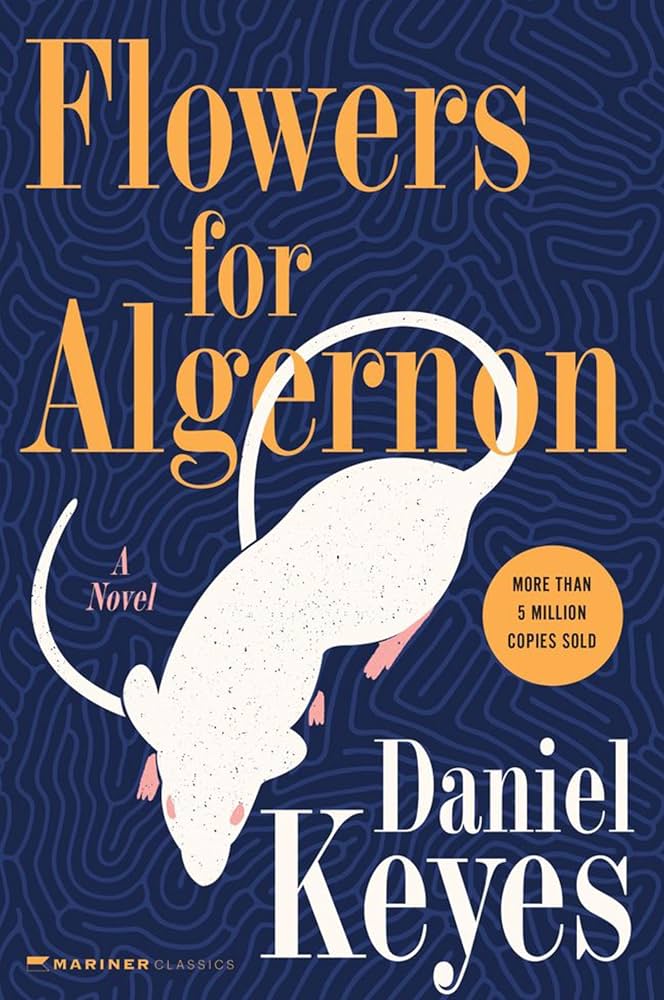
Flowers of Algernon is a devastating exploration of human intelligence; Daniel Keys masterfully strings a narrative that is hopeful and harrowing, staring right at the worst parts of humanity when we’re given the weapon of indifference.
Flowers of Algernon is one of the books my mother bought for me in middle school but one I never got around actually reading, until now. When I picked it up, some of its pages were folded and scrapped up already, time having done its part in rusting down the book. There was almost something so weirdly melancholy about reading such a “used” book for the first time.
This book was such a devastating story to me; as someone who gets very attached emotionally to everything I read about, Charlie as he navigates his life in both spectrums of intelligence was such a harrowing look at the worst part of humanity. How people in his life treated him, from the fellow workers at the bakery to even his own mom, made my blood boil with a tinge of sadness because it was unmistakably meant to be a realistic portrayal of what happens to real people among us. And the worst part? Charlie doesn’t even know this. It broke my heart every time Charlie laughed alongside people who were making fun of him; and I couldn’t help thinking how easy it is for the privileged few to sit in this seat of indifference when there are people out there who are going through struggles we will never know about. Even his mother would’ve forgotten about her own son than to help him find a better life with love and care.
“I am afraid. Not of life, or death, or nothingness, but of wasting it as if I had never been.”
However, perhaps the most striking part about this novel is the stylistic choice to accompany his journey with the actual physical implementation of grammar of his diary entries. In other words, the book begins with a messy combination of spelling errors, incorrect use of common grammar techniques, and some questionable diction and narrative choices. This, of course, is representative of Charlie’s intellectual disability at the start of the novel. However, after he gets the new “technological” treatment and his intelligence slowly but steadily thrives, he makes less mistakes and he rapidly starts to sound like an educated researcher with years of experience. I found it so engaging to see this change happen on the very page, and it was definitely an amazing choice by Keys to really bring Charlie to life.
“Now I understand that one of the important reasons for going to college and getting an education is to learn that the things you’ve believed in all your life aren’t true, and that nothing is what it appears to be.”
But the real thing that made this choice so compelling was when his grammar began to decline, not improve. The very first time that he makes a mistake after chapters of talking about philosophy, and other university-level disciplines, I just knew something was wrong and the story was going down a dark turn. It added a sense of hopelessness to the readers; you are seeing this deterioration of Charlie’s in front of your very eyes, but you simply can’t do anything but to sit and read what’s unfolding. When I finally came to the last couple of sentences (including the famous last line), I was literally crying tears of sadness.
Overall, this book was a roller coaster of a ride. It does such an incredible at portraying the perspective of this young man who has so much love to give but no one to give it to. I know for a fact that I would come back to Flowers of Algernon in the future just to meet Charlie again, and hug him. 5/5.
“Thank God for books and music and things I can think about.”


Leave a Reply