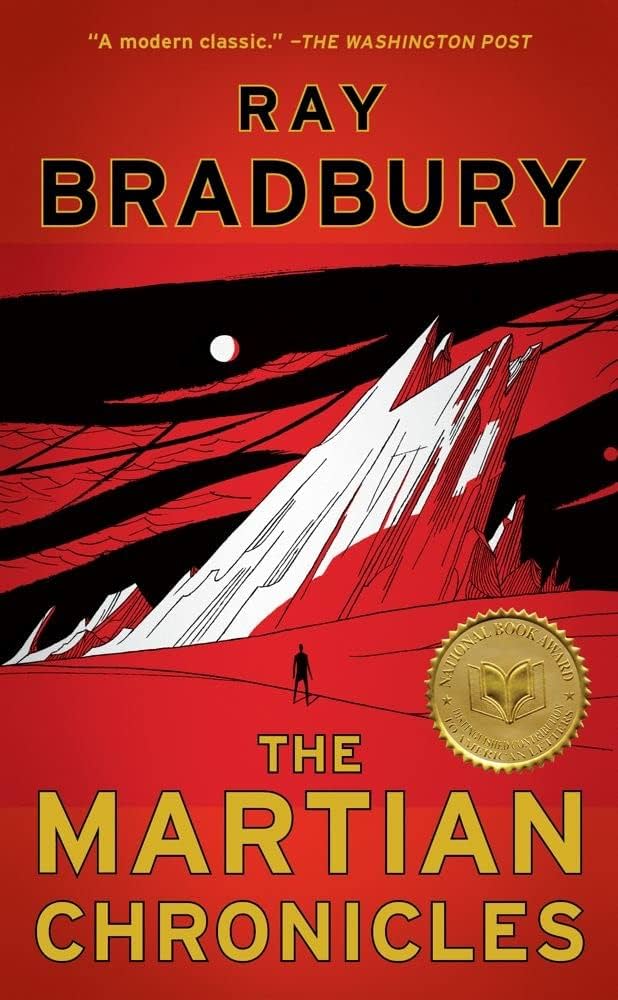
The Martian Chronicles is an allegory of humanity’s greatest flaws, mirroring the conquering of Mars to America’s war towards the western front. Wrapped inside our pursuit of outer space, is a lesson closer to home.
Genre: Science Fiction, Fantasy, Horror
Rating: 5/5.
“We earth men have a talent for ruining big, beautiful things.”
Having already read Fahrenheit 451, one of my favorite books of all time, I had such high hopes for another book by Ray Bradbury. I couldn’t wait to sink myself into the layered and masterful world that I knew he could build, and the real world implications of social commentary that is embedded into his narratives. I had enough trust to know what I was getting myself into, or I thought so. The one thing about the Martian Chronicles is that no amount of preparation would have prepared for me its immense quality. It might literally be one of the best books I have ever read, and that’s saying something.
Now, it may seem like I’m flaunting these compliments without actual evidence to back them up. But there is sufficient reason that this book has allowed me to appreciate the beauty and majesty of Bradbury. But before we get into those gritty details, I want to highlight the actual structure of this book. Because unlike a traditional linear plot, it’s made up of several short stories that are tied together not by characters or story beats, but by theme. Although I will touch on the significance of these stories later, this allows us to explore countless different settings that are so different from each other, and uniquely its own creative and living form. The genres range from fantasy to realistic fiction to horror in the blink of an eye. Stories are set on Earth, in Mars, and in places with no names. I can’t put it into words how much I loved the vast and immense world(s) that Bradbury created throughout, where there are no bounds to the things you get to read about.
“I’m not anyone, I’m just myself; whatever I am, I am something, and now I’m something you can’t help.”
The first thing I absolutely loved about this book was the prose. It’s not complex or hard to understand, but there is almost an effortless quality to how Bradbury strings together words. I would describe it as flowing, like a river. Each word connects to the previous one flawlessly to the point where I can think of any other way to phrase it; it’s not often that I feel such a way. There is almost a mystical and magical experience hidden inside each letter nook; I could read anything written like this book all day, every day.
My second favorite component is the worldbuilding of it all. Even ignoring the social commentaries, several stories (if not all) in this book can stand on their own by their sheer creative depth alone. I wondered at many points, how the heck did Bradbury think of this? From cool technological ideas to interesting magical mechanics, he even succeeded in writing a fantastic fantasy and science fiction book on its own merit.
“It is good to renew one’s wonder, said the philosopher. Space travel has again made children of us all.”
Now, lastly, we cannot not talk about the larger allegory, that of humanity’s biggest flaws. Bradbury masterfully mirrors the conquering of Mars to America’s war toward the western front, where the question of what will be and what is left rises. The Martians that are killed by disease and systematically murdered, the rewriting of history and censorship of literature, the implications of black segregation and slavery as we expand, and everything in between, this book is a physical manifestation of the historical issues that were alive when it was written. And dare I say, ever more relevant in contemporary society.
In conclusion, this book was more beautiful and impactful than I could’ve ever hoped and imagined. I wholeheartedly recommend it to literally anyone who is looking for a reflective but engaging read. 5/5.
“Science is no more than an investigation of a miracle we can never explain, and art is an interpretation of that miracle.”


Leave a Reply