Genre: Mystery, Terror
Rating: 5/5.
“I don’t know. I don’t know at all. And that’s what’s frightening the life out of me. To have no idea….”
And Then There Were None is a terrifying manifestation of human madness, a striking mystery with real stakes and power; despite its short length, the story it holds is anything but insignificant.
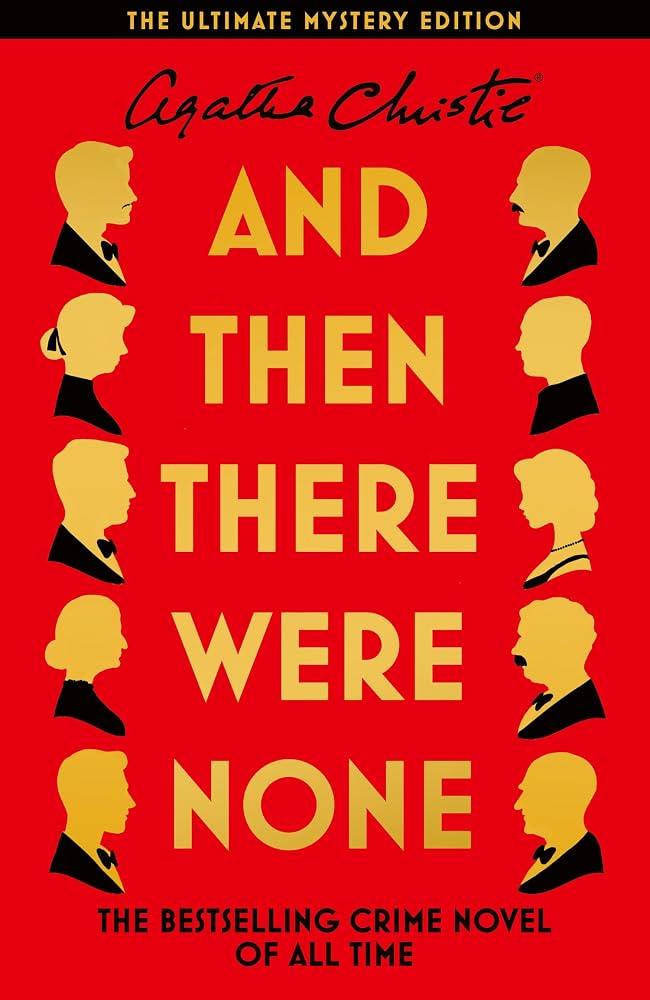
This is actually my second time reading And Then There Were None. About three years ago, I had borrowed it from my middle school library after an encounter with its black and red cover and absolutely intriguing synopsis, and sunk myself to the short, but one of the most impactful mysteries I’ve read so far in my life. Having read the Murder On The Orient Express, I took the opportunity to buy my own hard copy, and re-read. Just in time for summer.
“Many homicidal lunatics are very quiet, unassuming people. Delightful fellows.”
I must first add that mystery or horror of any kind is not my usual cup of tea. However, as many of you guys may already know, I have a soft spot for anything Agatha Christie. There is something about her prose that is instantly likeable; it’s not complicated nor hard to understand (quite surprising considering the complexity of her plot), but instead it allows the reader to really digest the content at hand. It almost invites them to solve the mystery with them, not trying to hide the culprit for the sake of being a difficult puzzle. Whenever I’ve read books by Christie, I’ve felt this sense of belonging; she gives every clue possible to help us believe that we are on the right track, and even when a plot twist occurs, it’s less about “oh, I couldn’t conquer this problem,” and more of “wow, it’s funny that I noticed this xyz detail!” Even when it becomes pretty violent or brutal, Christie makes this a safe space. This strength is what definitely makes her stand out, and why I love her so much.
“One of us in this very room is in fact the murderer.”
The structure of the lullaby of the same name is what makes this story so unique. The rhyme scheme, which we quickly learn is almost a prophecy, adds this sense of inevitability to the slow deaths of all of our characters. The question is not about if they die, it’s about how and why and when. It’s a pretty interesting angle to look at the idea of being trapped in a desolate island: I was on the edge of my seat for the entirety of the story, not able to wait to see how the song would manifest itself in real life. I was slowly descending into madness with the characters; seeing how unhinged and crazy they can become was so masterfully and exquisitely done, I could imagine the exact scenario happening in life.
“There was something magical about an island—the mere word suggested fantasy. You lost touch with the world—an island was a world of its own. A world, perhaps, from which you might never return.”
I cannot talk about this book without gushing about the plot twist. I remember literally gasping when I first realized that Judge Lawrence Wargrave was the mastermind behind all of it, and even in my second read, I still experienced chills at the reveal. From his fake death, collaboration with Dr. Armstrong, waiting until Vera hanged herself, and orchestrating his own demise, the maddening and scary planning of a judge with such a goal in mind is something that only Christie could’ve thought of. Her creativity, and unbound imagination, permeate every inch, and every word of this strikingly short book.
In conclusion, And Then There Were None, despite its short length, is anything but insignificant. It’s about human madness and kindness, and how when pushed to the limits, how far we will go to keep, and lose, everything we cherish. 5/5.
“But no artist, I now realize, can be satisfied with art alone. There is a natural craving for recognition which cannot be gain-said.”


Leave a Reply