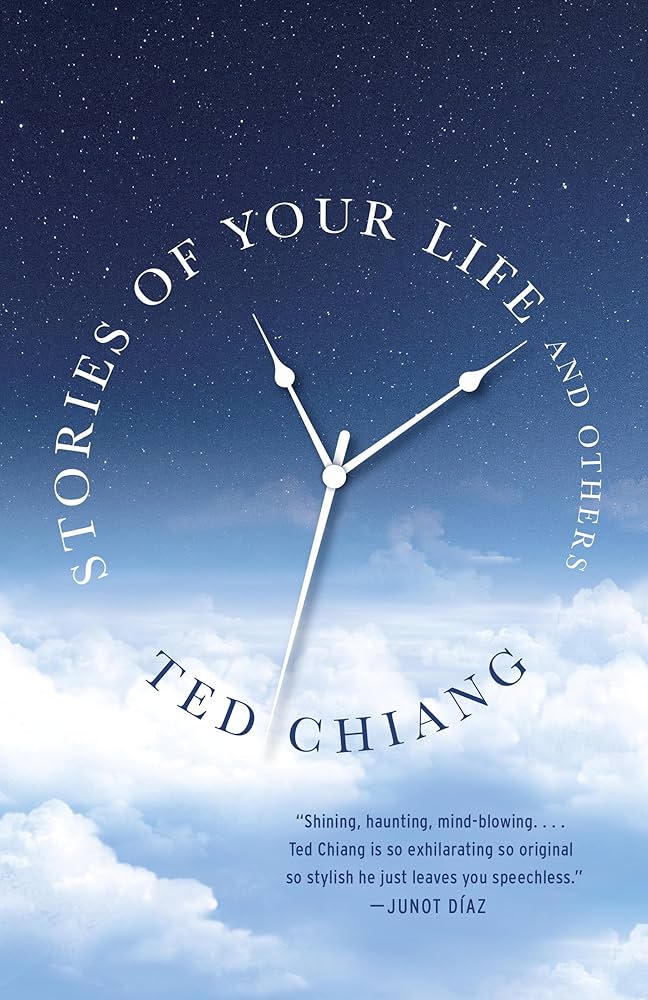
Despite its extensive exploration of science and mathematics, Stories of Your Life and Others ultimately details humanism in its most complete, and perhaps authentic, form.
Genre: Science Fiction
Rating: 4/5.
“Despite knowing the journey and where it leads, I embrace it and welcome every moment”
I have to admit, I’m not the biggest fan of science fiction. It may sound like a sacrilegious confession, I know, but I oftentimes find that stories that are overly futuristic tend to rely too much on the science, not the story. When I’m reading, I’m here to enjoy the characters and plot! Not how a certain physical or chemical discovery allows a machine to work; it becomes very detail-oriented, and frankly, quite dizzying. Of course, this doesn’t mean I haven’t come across some good science fiction books (shout out to my favorite The Murderbot Diaries!), but it’s definitely not something I instantly gravitate towards.
With that said, I had heard so many incredible things about this collection of short stories that I needed to give it a try. I thought, why not? And boy, I’m glad that I did.
“Unconditional love asks nothing, not even that it be returned.”
Fittingly, the one word I’d use to describe this book is exploration. Exploration of scientific discovery, yes, but more importantly, the exploration of what makes us human despite it. Each story focuses on a specific advancement in technology, whether it be a superhuman drug or an infinite tower of Babel that reaches up to heaven, and it so achingly describes how our capacity as a civilization is affected. Sometimes, it destroys us. Other times, political commentary ensues. One time, we literally meet an alien species and it alters our perception of time and language forever (we’ll get to that later). I can’t put it into words how much I loved such a nuanced take on science; with the increasing presence of AI in our lives, there are days I sink into this hole of pessimism about our future. Reading these diverse scenarios where humanity is still having these heated debates and embracing and co-exist with technology made the issue less daunting. And also emphasises the timeless quality of Chiang’s imagination.
Since this book consists of several, unique short stories, I’ll structure this review a little bit differently; I want to highlight two specific stories that have stayed with me the most after finishing the book. I think that would allow me to organize my thoughts more clearly (and for you to enjoy reading as well!).
“I knew it was foolhardy; men of experience say, “Four things do not come back: the spoken word, the sped arrow, the past life, and the neglected opportunity,”
The first short story is, of course, “Story of Your Life,” almost the main character of this whole collection. I did know some things about it beforehand, since it’s pretty famous for inspiring the popular movie Arrival. Figuring out a new language from an alien species? Sign me up! However, in all seriousness, I couldn’t have ever predicted how profound and thought-provoking this would be. There was something so mind-numbing about such a different species that literally experiences the past, present, and future at the same time. As someone interested in linguistics, I was mesmerized by the efforts of the people who deciphered possibly the most impactful discovery in civilization.
“The physical universe was a language with a perfectly ambiguous grammar. Every physical event was an utterance that could be parsed in two entirely different ways, one casual and the other teleological, both valid, neither one disqualifiable no matter how much context was available.”
The next short story I want to talk about is called “Liking What You See: A Documentary.” It’s positioned pretty late in the book, but it quickly became my favorite the more I brewed over its meaning. For context, it’s almost this societal debate over a new brain technology that allows people to disregard the bias of physical looks entirely; you have the chance to simply not be impacted by beauty or how “hot” someone is in your judgment of others. Of course, this has huge ramifications. University students express their own experiences with the ability; some love the idea and even detail the benefits in a romantic relationship, others not so much. Ultimately, it’s this idea of do we sacrifice inconvenience for something that is so intrinsic to us? It doesn’t give you an answer; instead, it poses you a question. To ponder, to think, and to maybe reach the conclusion that there is no right answer. As a youth, the story touched such a relevant topic so beautifully and made me definitely look at what makes us humans more deeply.
Ultimately, Stories of Your Life and Others was all about exploration, of science, of humanity, of fundamental truths of the universe. I was truly stunned by Chiang’s capacity as a storyteller the whole way through, and it’s a book I’ll definitely revisit in the future. ⅘.
“Be patient. Your future will come to you and lie down at your feet like a dog who knows and loves you no matter what you are.’ ”


Leave a Reply