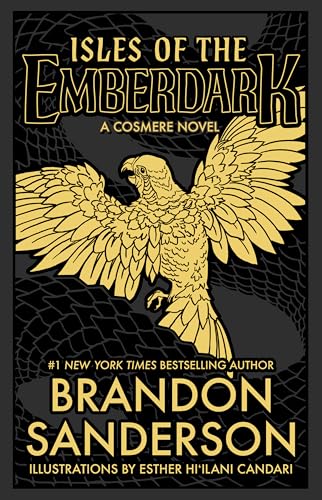
“Isles of the Emberdark delves into the inevitable clash between tradition and modernity, elevating the scope of the Cosmere to new heights.”
Genre: Fantasy, Science Fiction
Rating: 4.5/5
“Stories are important,” he said. “I live because of the stories of trappers, who told me what to avoid.”
Every time I open a new Sanderson book, I set out on a journey with incredibly high expectations. And without fail, he manages to exceed every one of them, astounding me with the depth and intricacy of the worlds he creates. Isles of the Emberdark is no exception to this rule; as the latest installment in his Secret Projects, it offers a fresh perspective on the space-age Cosmere, skillfully blending ancient magic with modern innovation.
One particularly fascinating aspect of this book is that it serves as a continuation of Sanderson’s previously published short story Sixth of the Dusk. Here, he expands the scope of that original world, deepening its lore and pushing its boundaries in compelling new directions. And as someone who had never read the original story, I was impressed by how seamlessly Sanderson wove it into this book, using it as an effective flashback sequence in the first part; the narrative was interesting enough that it didn’t feel out of the ordinary, and I think Sanderson made the perfect choice in introducing Dusk’s character to new readers. Adding the extra POV of Starling, in my opinion, worked very well in creating a more extensive and nuanced view on the initial theme without taking away anything; their interaction was really heartwarming to see, and such a good development.
“Tell me. Is there a place on your planet where people vanish unexpectedly? A place, perhaps, where an odd pool collects something that is not quite water?”
Speaking of Dusk, I couldn’t help but fall in love with the blunt yet good-humored personality that makes up who he is. There were countless moments when I laughed out loud simply because his matter-of-fact outlook on life bewildered those around him. Despite others’ assumptions about him or his planet, Dusk’s intelligence and deep-rooted desire to protect what he cares about shined through every page, and that commitment was something I really appreciated. Additionally, his journey of resisting, and eventually begrudgingly accepting, modernity in the face of his culture’s slow disappearance is portrayed with remarkable complexity; Sanderson captures the tension between preservation and progress in a way that feels both personal to Dusk and universal to our world. Interestingly enough, he does not attempt to paint either in a negative light, and rather than vilifying it, he uses Dusk’s experience to emphasize the importance of adapting to our inevitable march towards a better, yet worse, future.
Starling, on the other hand, offers a striking contrast to Dusk. As the first dragon point-of-view we’ve encountered in the Cosmere, she brings a vast knowledge and deep understanding of the universe’s inner workings, a perspective Dusk simply can’t offer. Through her narrative, Sanderson explores a different thematic thread: the enduring power of hope and trust. Her belief in her crew—made up mostly of outcasts from various cultures—embodies this theme, as they unite in pursuit of a shared purpose, breaking down barriers to help even those they’re not sure they can trust. It was genuinely heartwarming to read about Starling and her crew, whose compassion and willingness to believe in something greater left a lasting impression on me.
Conclusion In conclusion, Isles of the Emberdark was a delightful addition to the Cosmere, balancing future technology with the traditional and magical elements we love so much. I would wholeheartedly recommend this book to anyone looking for a story full of energy and hope in an interconnected world. 4.5/5
 colinbooks
Leave a comment